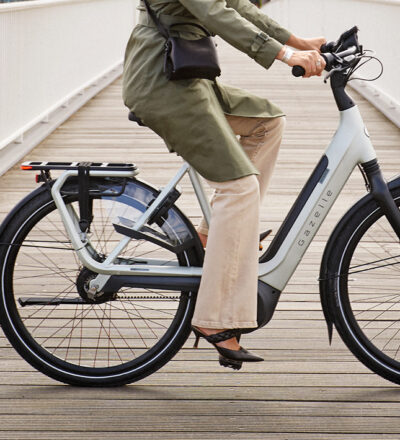
The use of recycled plastics in high-quality technical products is still a challenge. In particular, engineering plastics must meet high standards in terms of strength, impact resistance, weather resistance and dimensional stability. Nevertheless, the ReCYCLE-project demonstrates that high-quality circular applications are indeed possible. In this project, five plastic components of electric bikes have been successfully developed using recycled engineering thermoplastics.
The popularity of e-bikes is still growing strong. Thereby, the use of technical plastics is too. Parts such as chain guards, battery housings and engine covers are traditionally produced from new engineering plastics. To meet the climate goals of both the Netherlands and the European Union, a shift to circular use of these materials is needed. The ReCYCLE-project therefore focused on closing the material loop for high-quality technical plastics in e-bikes.
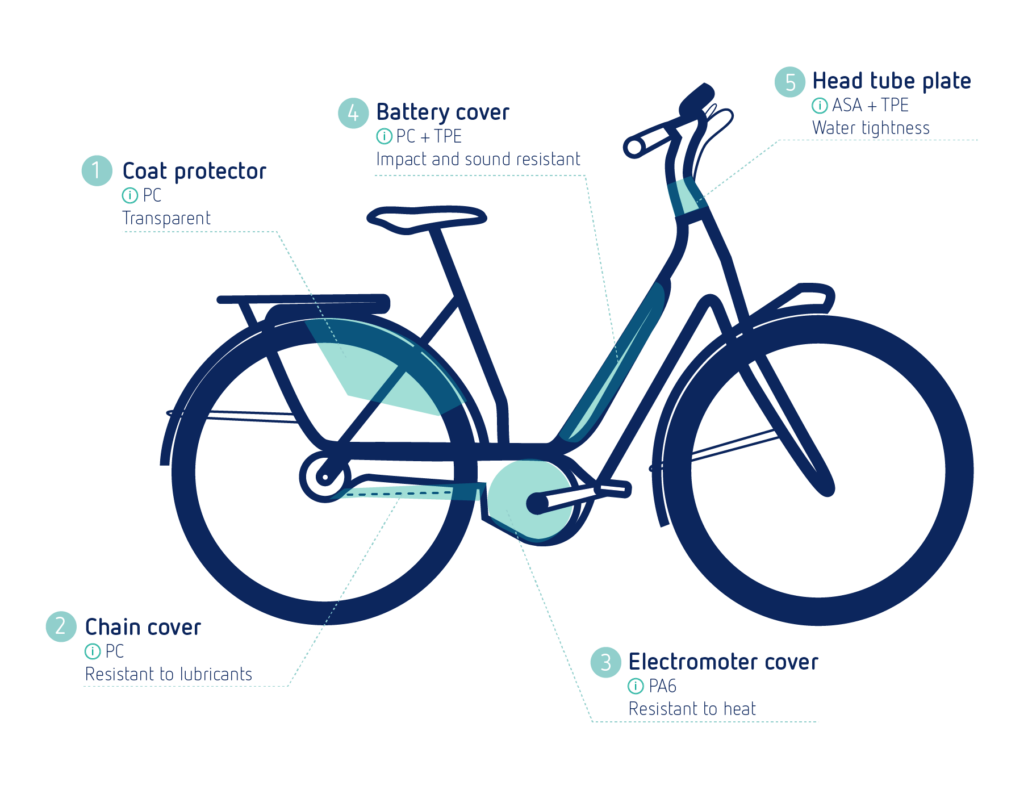
Instead of completely redesigning new products, the project partners chose a step-by-step approach. First, an investigation was carried out to determine whether existing components could be produced from 100 per cent recycled material without any design changes. Only when this proved impossible were material optimisations, design modifications and, ultimately, complete redesigns carried out in succession. This made it possible to find the most efficient circular solution for each component. The research focused on five components of an electric bicycle: the chain guard, the electromotor cover, the battery cover, the coat guard and the head tube plate. For each component, the technical requirements were precisely defined. Subsequently, prototypes were manufactured and extensively tested for, amongst other things, mechanical properties, weather resistance, chemical resistance, aesthetic quality and assembly characteristics.
An important result of the project is that all five components could successfully be produced using recycled engineering thermoplastics. It turned out that black PCR-ABS is a good alternative for both the chain guard and the motor cover. This also has the advantage that both components can be recycled in the same material stream after use. For transparent components, such as the jacket protector, recycled PET and recycled polycarbonate proved to be suitable solutions.
A logistical challenge too
In addition to developing the components, the researchers also assessed the availability of recycled engineering plastics. Their findings show that some materials, such as PCR-ABS, are now readily available, whilst other recycled plastics are still only available to a limited extent. For some polymers, there is barely any commercial recycling stream at all. This underlines that the further development of high-quality recycling is not only a technical challenge, but above all a logistical one.
The ReCYCLE project was carried out as part of the Circular Plastics Initiative (CPI). This is a partnership between the Institute for Sustainable Process Technology (ISPT) and the Dutch Polymer Institute (DPI), in which research institutions and companies are working on industrial applications of circular plastics. Partners in ReCYCLE are Koninklijke Gazelle, Timmerije, UltraPolymers, Brisk-Kumet and Polymer Science Park. The project is co-funded by a grant from the Topsector Energy by the Ministry of Economic Affairs and Climate Policy.
A degradation model
To gain an understanding of the service life of recycled plastics, the researchers also developed a so-called degradation model. This involved investigating how recycled ABS and polycarbonate behave following repeated mechanical recycling and accelerated ageing. The results show that, whilst impact strength does decrease following a recycling step, most other mechanical properties are largely retained. It is striking that recycled ABS performs significantly more consistently than recycled polycarbonate. It also appears that the ageing behaviour of post-consumer recyclate closely corresponds to that of virgin material.
Furthermore, provided that any loss of quality remains within acceptable limits, the materials can be reused several times. According to the researchers, ABS is suitable for five to fourteen recycling cycles, whilst polycarbonate can be reused to a high standard two to four times. From an environmental perspective, too, the use of recycled engineering plastics offers significant benefits. Based on a life-cycle analysis, a CO₂ reduction of approximately 55 to 68 per cent was calculated for various components compared to components made from virgin material. However, the study shows that long transport distances for recycled material can partially reduce the environmental benefits. Regional availability of high-quality recycling streams therefore remains important for a truly circular plastics supply chain.
According to the project partners, the results extend beyond the bicycle industry alone. The knowledge gained regarding recycled engineering thermoplastics, design rules and material behaviour can also be applied in sectors such as the automotive industry, electronics and other high-quality plastic products. ReCYCLE thus represents an important step towards a broader application of circular engineering plastics in the manufacturing industry.
| Component | Virgin material | Circular material |
|---|---|---|
| Chain guard | ABS black | PCR-ABS black |
| Motor cover | PA6 black | PCR-ABS black |
| Battery cover | PC black | Impact-resistant PCR-ABS |
| Coat protector | PC transparent | PCR-PET transparent or PCR-PC |
| Head tube plate | ASA + TPE | 2K: PCR-ABS + PCR-TPE / 1K: PCR-ABS black + silver-coloured PCR-ABS |
Virgin materials after all?
This project shows that there are many possibilities when it comes to using recycled materials, even when it comes to high-end applications. Yet by no means all clients – and brand owners in particular – are keen on this. There are quite a few entrenched assumptions that ultimately tip the balance back in favour of virgin materials. We asked two project partners – bicycle manufacturer Gazelle and injection moulding specialist Timmerije – about their experiences regarding the considerations involved in deciding whether or not to opt for recycled materials. At Gazelle, the perspective is that of an OEM, whilst at Timmerije it is that of an injection moulding company and materials processor.
‘How do companies currently view the use of recycled plastic for high-quality applications such as bicycle parts, and what do you think ae the biggest barriers to working with it?’
Hans Kolnaar, managing director at Timmerije: ‘The biggest barrier relates to the design requirements of the original equipment manufacturer (OEM): if, for its technical plastic components, the OEM demands that the product has the same properties across the board as virgin material “as it has always been”, then the use of recycled material is usually limited. What is needed is for the OEM to assess what is truly ‘critical to quality’. This means that all existing properties must, in fact, be reconsidered. Another barrier concerns the availability of pure engineering plastic recycling streams. These do not come from the PMD bag, but are generated during the dismantling of items such as cars and electrical and electronic products.’
Guido van Rijckevorsel is team leader of Mechanical Engineering at Koninklijke Gazelle NV: ‘For many manufacturers (OEMs), including ourselves at the start of this process, the lack of specific knowledge about recycled engineering plastics is the biggest barrier. Unfamiliarity breeds distrust; it quickly feels more complicated and riskier to opt for a recycled alternative during the design phase of a new product. Within the ReCYCLE project, we have successfully bridged this knowledge gap and demonstrated that the risks can be effectively managed.’
‘There is often a perception that recycled plastics are more expensive or perform less well than virgin plastics. Do you recognise this perception, and where exactly does the problem lie in practice?’
Hans Kolnaar: ‘This perception does indeed exist, but it is often incorrect, as has become apparent. We are talking here about engineering plastics, not commodities. Recycled engineering plastics are generally cheaper than virgin polymers, which also creates an economic incentive to make components circular. The properties of recycled plastics are at most equivalent to those of virgin polymers, so not all properties – such as stiffness – are compromised. What the ReCYCLE project has shown is that the reduced properties can often be compensated for through chemical modification (such as impact modifiers in ABS) and/or design adjustments (such as local thickening) to the plastic product. The design rules for using recyclate are the reverse of those for virgin material. With virgin materials, you first optimise the design and then look for the ideal plastic; with recyclates, you first look for a readily available stream that has properties close to those of the virgin material. You then modify the raw material or adapt the design to accommodate the recyclate.’
Guido van Rijckevorsel: ‘That perception is very common in the market, but if you take the time to really look into it properly, you’ll come to a completely different conclusion. As part of the ReCYCLE project, we have in fact demonstrated that these assumptions are often unfounded. Recycled alternatives do not have to be more expensive at all, and their performance can more than meet strict quality requirements.’
‘This project demonstrates that collaboration within the supply chain is crucial. What did you investigate together, and why was it precisely that collaboration that was needed to achieve these results?’
Guido van Rijckevorsel explains that at Gazelle they are impressed by the combined expertise within this consortium. ‘Each participant represented a different link in the supply chain. That was truly crucial: to arrive at a workable solution, you need all perspectives. Whilst one focuses on the price and availability of the recycled material, another looks at processability in the injection moulding machines, at the mould requirements or at possible material tests. As an OEM, we focus on the final product properties, such as mechanical strength, colour and scratch resistance. By bringing all these perspectives together, we learnt a great deal from one another and arrived at a comprehensive solution.’
Hans Kolnaar adds: ‘The story is actually very simple: To make (technical) plastics products circular, you need knowledge of the availability and properties of recycled materials, material properties, ageing behaviour of plastics, and the modification of material properties, processing of recycled materials, injection moulds, plastics products, the end use and consumer preferences. No single party possesses all of this knowledge. That is why you need to build an ecosystem to make this possible. You can then partly reuse this ecosystem in a subsequent project.’
‘What are the key findings of this project in terms of the costs and functionality of recycled engineering plastics compared to virgin material?’
Hans Kolnaar states that recycled engineering plastics are cheaper than virgin ones, but efficiency in the injection moulding process may be slightly lower and the weight of the product may increase slightly. ‘The aesthetic requirements of the OEM determine, in the case of recyclate, how much waste there is in the process. Actually, the OEM should be a little more tolerant: this is also a task for the plastics processor. Finding the right recyclate stream and fine-tuning the process takes time. On balance, the circular product is competitive with the product based on virgin material. ’
Guido van Rijckevorsel: ‘The most important conclusion for us as an OEM is that, for the vast majority of our applications, recycled materials exist that are both cost-effective and technically suitable. The most crucial lesson, however, is that the design approach must change: you have to design with an understanding of the recycled material. That works much better than trying to find a suitable material after the fact for a design that has already been finalised.
‘What does this mean in practical terms for end-users and recyclers in the Netherlands? And why is now the perfect time to invest in recycled engineering plastics as a profitable business case?’
Guido van Rijckevorsel: ‘From our perspective as an OEM, we see enormous potential. Now that we have proven that it is technically and commercially viable, we hope this will stimulate the market. If the availability of these materials increases and knowledge about them is shared more widely, recycled engineering plastics can be used on a much larger scale.’
Hans Kolnaar: ‘As far as recyclers are concerned: the Netherlands needs a hub for the disassembly of cars, white goods and E&E products to recover engineering plastics and other materials. At present, recycled materials are still mostly sourced from abroad. As for end users: the circular economy narrative needs to be marketed more effectively. We need to start looking at the value of sustainable products in a different light: perhaps we should learn to appreciate ‘perfect imperfections’ more?’
To conclude, Kolnaar would like to say a few words about project partner Polymer Science Park (PSP). ‘It was recently announced that PSP Zwolle has gone into liquidation. Their contribution to the ReCYCLE project has proved to be extremely valuable. The government in the Netherlands should be doing more to create – and maintain – the right conditions for a circular economy, including a knowledge infrastructure.’
This article is written by Kunststof-magazine.
Acknowledgement
This project is co-funded with subsidy from the Topsector Energy by the Ministry of Economic Affairs and Climate Policy.