Through its Circular Plastics Initiative (CPI), ISPT aims to accelerate plastics circularity on an industrial scale. One of the most promising tools for improving the sorting and pre-treatment of plastic waste in recycling processes is Artificial Intelligence (AI). The technology is already enhancing the effectiveness of existing sorting lines and, through vision-based applications, can support the identification, classification and potentially even the removal of contaminants. Combined with product data, such as a Digital Product Passport (DPP), AI could represent a major step forward for the sector. Developments are progressing rapidly and offer clear prospects for improving both yield and quality.
The recycling of plastics, most commonly packaging materials, relies on the effective sorting of waste streams before processing begins. This remains a significant challenge due to the wide variety of plastic types present, each requiring different treatment methods. In addition, maintaining visibility of material quality before and during processing is essential for ensuring the quality of the resulting recyclate.
Ronald Korstanje, Program Director of CPI explains: “Monitoring provides opportunities to intervene when necessary and maintain a clean material stream that is suitable for further processing into new products. At the same time, plastic volumes continue to increase, further strengthening the need for automation.”
Circular Plastics Initiative
For more than two decades, ISPT has served as an independent innovation platform, facilitating collaboration between knowledge institutes, companies and value chain partners to accelerate the major transitions in energy, materials and agrifood. In the field of plastics recycling, the organisation has spent recent years bringing together end users, research institutes and suppliers of technologies such as sensors and AI solutions.
This collaborative approach combines knowledge and experience to enable targeted measurements throughout sorting and processing operations. AI can evaluate the resulting data, predict input-output relationships and ultimately intervene autonomously in processes to better align outcomes with product specifications.
Several initiatives are currently underway within ISPT, including a number that form part of the Circular Plastics Initiative (CPI). CPI was launched in 2019 in collaboration with the Dutch Polymer Institute (DPI) and a range of (industrial) partners. The programme explores alternative sorting methods and the optimisation of processing technologies, with a particular focus on how AI can support waste sorting and processing companies in improving their operations. The ultimate objective is clear: to guarantee the consistent production of high-quality recyclates.
Marta Konopinska, who works within ISPT’s Industry 4.0 and CPI programme, notes: “Various organisations throughout the value chain have been applying identification and characterisation techniques for some time to recognise products and plastic types, thereby improving the quality of separated material streams. With the rise of AI, the possibilities appear to be expanding even further. ISPT’s strength lies in bringing together the right partners and ensuring that progress is maintained.”
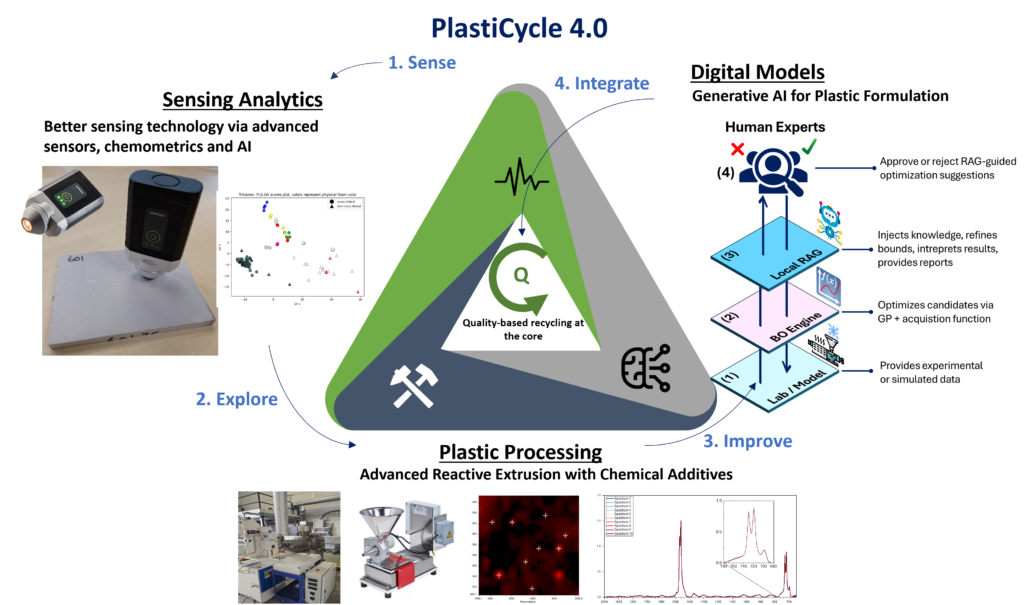
Project PlastiCycle 4.0
One of the projects within CPI is PlastiCycle 4.0, led by Dr Sin Yong Teng, who has been an Assistant Professor at Maastricht University for the past three years. His research focuses on developing and applying models that enable sustainable industrial processes to achieve equal or better performance in terms of quality and cost compared with conventional processes based on virgin fossil resources.
These models are applied at different scales, with the aim of developing theoretical algorithms that are informed by experimental and industrial data. The algorithms are designed to address bottlenecks on the path towards industrial implementation. According to Dr Teng: “I am particularly interested in research focused on industrial systems combined with plastics recycling. That made ISPT’s PlastiCycle project a perfect fit for my expertise.”

Together with his team of seven PhD candidates and postdoctoral researchers, as well as other knowledge institutes and industrial partners, Dr Teng is working to stabilise recyclate quality in the mechanical recycling of plastics. He explains: “The quality of mechanically recycled plastics can vary significantly, making it difficult to market these materials effectively. This creates an imbalance between supply and demand and hampers the wider adoption of associated recycling technologies. Nevertheless, we are keen to use mechanical recycling because it requires significantly less energy than alternatives such as thermo-chemical recycling.”
Research Objectives
The research focuses on three main objectives:
- Developing practical methods to predict and assess specific quality parameters that are crucial for the functionality of recycled plastics in various applications.
- Developing a new approach to evaluating the quality of mechanically recycled plastics.
- Expanding the knowledge required to produce high-quality recycled plastic products.
Determining Quality with AI
Sin Yong Teng also deploys AI within the second objective. “Within the project, we are developing methods to determine the quality of recycled PE/EPDM foam using AI. The entire value chain is considered, from incoming sorted plastic feedstock to the final product manufactured from it. Based on these insights, the preceding recycling and production processes can be further optimised. AI supports decision quality, accelerates process adjustments and helps identify the most promising directions for improvement. However, building a suitable AI model is time-consuming and remains a significant challenge.”
The first step involves creating a model based on domain-specific data, which is often unstructured. Potential solutions are then extracted from this data and enriched within the AI model using project-specific knowledge gathered and selected throughout the programme. This is achieved through Retrieval-Augmented Generation (RAG).
Dr Teng explains: “In essence, it is a chatbot that you can literally interact with. It can transform speech and other forms of unstructured data into relevant knowledge. Building a robust model requires substantial effort, but the rewards are considerable. Success would improve the value of the material stream and ensure a consistent level of quality. Ultimately, this leads to the production of more high-value products from recycled materials, benefiting all stakeholders involved.”
MPPS Project: Proof of Concept

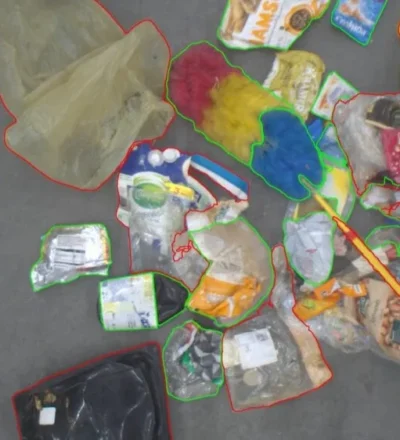
Within the waste transfer station use case of the Multipurpose Plastic Sorting (MPPS) project, research has been conducted into a technology designed to minimise the loss of valuable packaging plastics at transfer stations.
The project was initiated by Midwaste. Jurgen de Jong, Director of Strategy and Innovation, explains: “At waste transfer stations, incoming waste loads are visually inspected for objects that do not belong in source-separated lightweight packaging waste (LWP) streams. These objects are manually removed by an operator. However, visual identification involves a considerable degree of subjectivity, leading to the rejection of a significant number of loads that could otherwise be recycled. As waste streams become increasingly complex, particularly with the addition of metal packaging and beverage cartons, the need for a more objective solution has become clear.”
Testing Two Models
For Midwaste’s specific use case, the focus was on developing an AI vision-based technology capable of detecting and classifying contaminants within correctly collected lightweight packaging waste.
Two AI vision approaches were evaluated:
- Existing object classification models.
- A custom-developed anomaly detection model.
The study concluded that current object classification models are not suitable for application at transfer stations due to the enormous diversity of contaminating materials and the extensive training datasets required. The custom anomaly detection model, however, demonstrated promising results.
Lieuwe Hendrik Lei, Research Engineer at NTCP, explains: “Within this model, we use a vision system that converts waste streams into digital images, which are then analysed using tools such as ChatGPT. These systems possess extensive background knowledge that enables them to classify objects as either ‘plastic’ or ‘non-plastic’ anomalies. This allows the system to quickly identify challenging objects such as textiles, nitrous oxide canisters and large pieces of film.” The model is currently at the proof-of-principle stage.

De Jong emphasises: “The vision system and AI are not intended to replace operators. Instead, they act as an intelligent assistant on the work floor. The technology provides objective support in recognising and assessing materials, while operators remain in control and make the final decision on whether an object should be removed.”
The project has successfully demonstrated the proof of principle. However, substantial work remains before the technology can be implemented on a large scale and progress from Technology Readiness Level (TRL) 2-3 towards practical deployment. AI will undoubtedly continue to play a key role. Not only in object recognition, but also in combining visual observations with background data, such as a Digital Product Passport (DPP). Further ahead, AI may even be used to control robotic systems capable of removing targeted objects from material streams automatically.
Looking Ahead
Do you have an innovative idea, an AI application that could contribute to plastics recycling, or are you looking for project partners to help solve challenges in this field?
ISPT welcomes collaborations with organisations across the value chain. Together, we can accelerate the development of smarter, more efficient and more circular plastics recycling systems.
Interested in getting involved? Please get in touch with us.
This article was previously published on npt.pmg.nl