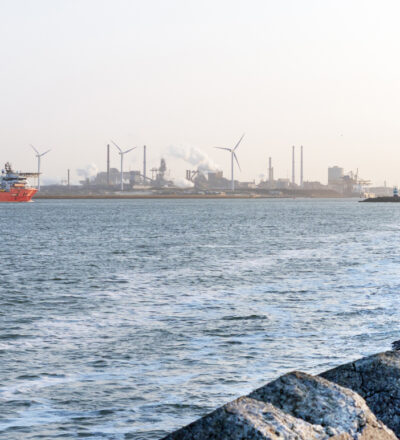
Steel companies in Europe are grappling with how to decarbonize while remaining competitive. The sustainable process technology institute ISPT sees opportunities for profitable carbon-neutral steel production through integration with circular chemistry.
“When you walk around a steel plant as a chemist, you really begin to realize how unusual the production process actually is. We have been making steel in contact with open air for more than three thousand years, whereas chemical plants have been designed as closed systems from the very beginning.”
Tjeerd Jongsma can hardly be stopped when enthusiastically explaining an alternative plan to make steel production in Europe fully carbon-neutral at relatively low cost. Green steel, but affordable.
The Institute for Sustainable Process Technology (ISPT), where Jongsma has been director for sixteen years, developed an unconventional plan based on the idea of transforming steel production into a closed process. The core concept, devised by Program Director Kees Biesheuvel, revolves around carbon-neutral steel production through collaboration with the chemical industry.
When you walk around a steel plant as a chemist, you really begin to realize how unusual the production process actually is
Green Steel Struggles to Gain Momentum
Virtually all green steel initiatives focus solely on the production process within the steel plant itself. The resulting solution typically involves replacing the traditional blast furnace, where oxygen is removed from iron ore using coal. This core process generates substantial CO2 emissions.
The alternative, known as direct reduced iron (DRI), uses iron ore in pellet form. The oxygen can then be removed from the iron ore using substances such as hydrogen or methane (natural gas).
If green hydrogen is used for iron ore reduction, enormous amounts of renewable electricity must be available for hydrogen production. Using methane creates a different challenge: dependence on natural gas imports and, consequently, vulnerability to high gas prices during periods of geopolitical instability.
Several green steel projects are underway in Europe, but all face significant uncertainties regarding the viability of their business case. This also applies to the Green Steel Plan of Tata Steel in IJmuiden, for which up to €2 billion in state aid has been requested.
A Closed System for Steel Production
According to Jongsma, the business case for green steel can be made viable by approaching several aspects differently. “The most important change is that you no longer carry out the iron ore reduction process with air, but with a mixture of oxygen and CO2. This allows you to build a closed system, leaving a residual stream of carbon monoxide. That stream can then be used as a feedstock for the chemical industry.”
Pig iron could still be produced using a blast furnace, but within a system where carbon compounds are fully captured and reused.
According to Jongsma, coal could initially continue to be used for iron reduction, while residual streams such as biomass and plastic residues could gradually be added. “In such a modified setup, it becomes easier to obtain a pure carbon monoxide stream at the end of the process.”
This would require only limited modifications to a steel plant. “Conventional steel complexes already have oxygen production facilities on site. Existing oxygen production can therefore be expanded. In addition, the blast furnace installations need to be modified, but this is far less costly than establishing a direct reduction process.”
Steel production becomes carbon-neutral, and plastics can be produced more sustainably.
Investing in Chemistry
To make the business case work, another major investment would be required: a chemical plant for the production of methanol and fuels, carrying a price tag of several billion euros.
Such a plant can operate using two feedstocks: carbon monoxide and hydrogen. “If a steel plant can guarantee the supply of carbon monoxide, all you still need are electrolysers to produce green hydrogen using renewable energy. You then have the ingredients to produce methanol on the one hand, as a basis for products such as plastics, and fuels such as kerosene on the other, using gas-to-liquids technology.”
In this way, Europe’s chemical sector could become circular on a truly large scale, says Jongsma. “Steel production becomes carbon-neutral, and plastics can be produced more sustainably.”
Another advantage, according to Jongsma, is that competing with crude oil as a feedstock becomes easier. “That is strategically attractive. Tata Steel Netherlands alone could already enable the Netherlands to reduce oil imports by 3 million tonnes per year. In this way, dependence on imported oil for fuels such as kerosene could be substantially reduced.”
What is interesting, however, is that the iron ore reduction process in a DRI plant can use not only hydrogen or natural gas, but also carbon monoxide.
Opportunities for Europe
Last week, research institute ISPT presented the plan to stakeholders from both the steel industry and the chemical sector. Jongsma is looking beyond Tata Steel Netherlands alone: “Besides IJmuiden, the key North-West European steel clusters are located at ThyssenKrupp in Duisburg, ArcelorMittal in Ghent, and the Tata and British Steel plants in the UK.”
The involvement of the chemical sector is also required, particularly companies with experience in producing liquid fuels from gases using Fischer-Tropsch technology. These include companies such as Shell and the American company Dow Chemical.
The prospects for this cross-sector approach will depend heavily on trust from both sides: a steel producer with a strong market position that can credibly act as a long-term supplier of carbon monoxide, and a chemical company that sees sustained European demand for circular plastics and non-fossil transport fuels.
The Dutch government is expected to make a decision in early 2027 on the proposed state aid for Tata Steel’s current Green Steel Plan. The plan is based in part on replacing blast furnaces with a direct reduced iron (DRI) installation using natural gas.
“We explicitly do not want to intervene in that process,” says Jongsma regarding ISPT’s position. “What is interesting, however, is that the iron ore reduction process in a DRI plant can use not only hydrogen or natural gas, but also carbon monoxide. One option therefore does not necessarily exclude the other.”
This article was previously published by Change Inc.