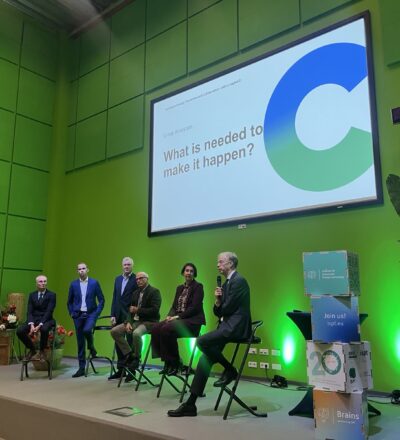
Instead of emitting CO2, the blast furnaces at Tata Steel should supply carbon monoxide as a raw material for the chemical industry. ISPT presented this model on Thursday at its annual conference in Terneuzen. ‘With this sort of process in steel production, you’re talking about volumes that are suitable for the chemical industry,’ says director Tjeerd Jongsma.
ISPT held the conference at the CO3 Campus in Terneuzen, in collaboration with North Sea Port, to mark the institute’s twentieth anniversary. Jongsma explained the model alongside Kees Biesheuvel, director of ISPT-Brains.
Out with the nitrogen, in with the CO2
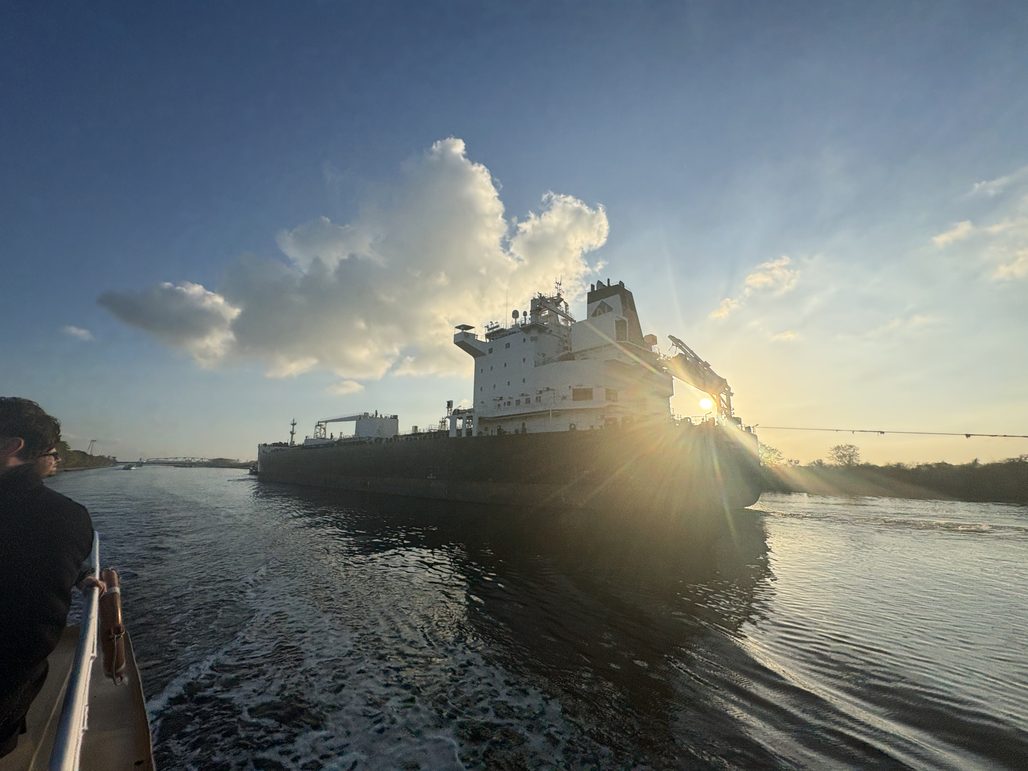
The idea began with a photo that Jongsma sent to Biesheuvel via a messaging app. ‘You can see large plumes of smoke coming out of the chimney,’ says Jongsma. ‘Actually, the steel-making process is a chemical process. At Tata, they carry it out in a relatively open process. And the question is: can’t we simply close that process?’ According to Biesheuvel, the photo led to a discussion about the steel-making process and previous attempts by ISPT. ‘And then we suddenly had an “aha” moment.’
A blast furnace uses carbon to extract the oxygen from the iron ore. This leaves the furnace as CO₂ and partly as carbon monoxide, which can be utilised in chemical processes. However, the nitrogen from the air gets in the way, explains Biesheuvel. ‘What if we didn’t put that nitrogen in at all?’ Injecting oxygen alone doesn’t work properly because of the flammability. ‘We’re actually proposing to replace that 60 per cent nitrogen with CO₂,’ says Jongsma. ‘And then you’re left with just oxygen and CO₂.’
According to Biesheuvel, the gas coming out of the furnace is easy to separate. The CO₂ goes back into the furnace, whilst the carbon monoxide is sent to a process that adds value to it. ‘Then you can use it to make all sorts of things: methanol, diesel, kerosene.’
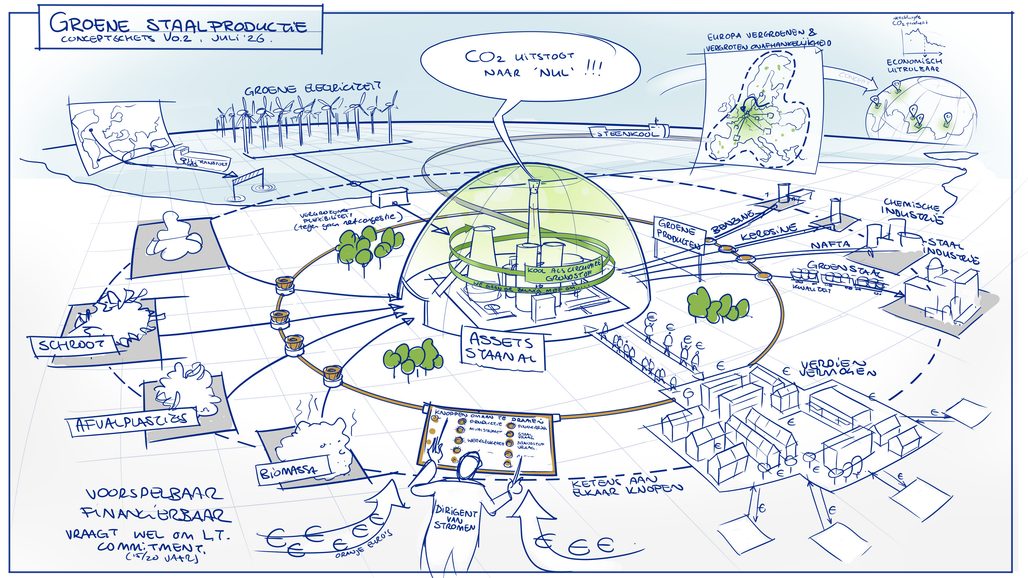
‘You keep the problems in-house,’ says Biesheuvel. ‘That way, a steel company doesn’t just become a steel producer, but also forges a link with the chemical sector: the carbon-processing industry, which currently still relies on fossil fuels. That knowledge and expertise is already in place there. And you already have a large proportion of your facilities – the blast furnaces and downstream plants – in the Botlek.’
Upgrades to existing installations
In the long term, ISPT also wants to use waste plastic to produce new steel. According to Jongsma, this cannot be done all at once. Anyone wishing to use only waste plastic as a raw material will need wind farms in the North Sea to generate the hydrogen, and these do not yet exist. ‘That doesn’t mean you’re having a revolution, but rather an evolution towards a circular system. And in doing so, I’m still using the existing “pots and pans”, because otherwise nobody will invest.’
In the first stage, the steelworks still uses coal, but utilises each carbon atom twice. ‘If you can use a carbon atom twice in the first stage, you’ve already achieved an immediate 50 per cent reduction,’ says Jongsma. ‘Take an average steelworks with two blast furnaces; that produces an average of 10 million tonnes of CO₂ emissions,’ says Biesheuvel. ‘The Netherlands emits a total of 120 million tonnes, so this represents a massive reduction in CO₂ emissions.’
Steel companies interested
ISPT has put the idea to ArcelorMittal and Tata Steel. ‘They are very interested,’ says Biesheuvel. ‘We do realise that this won’t happen overnight.’ One company cannot set up such a supply chain on its own, says Jongsma. The evening before the conference, ISPT asked petrochemical companies if they would like to get involved. According to him, everyone is positive, but the business case still needs to be worked out.
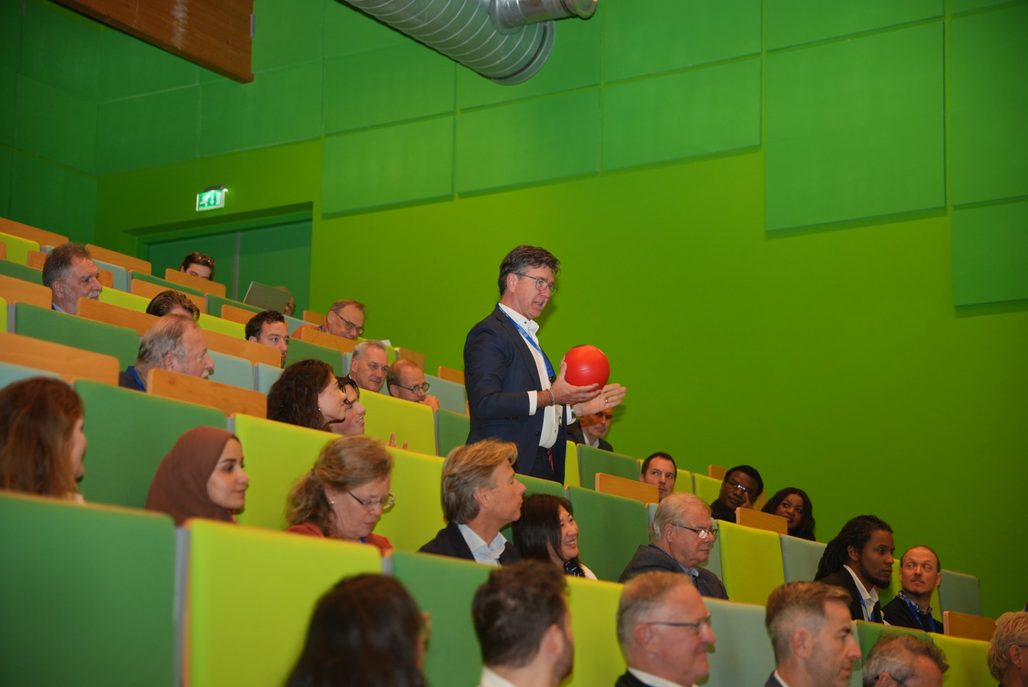
There was, however, some criticism from the audience. One visitor pointed out that the end product is based on fossil carbon and that it would therefore have to compete with fossil fuels on the market. And that price will not be achievable. ‘We mustn’t try to write the whole thing off before we’ve even started,’ responds Jongsma. ‘If we focus too much on the risks, it won’t take off. The environment stands to benefit immediately, and this is an intermediate step towards circularity.’
Not all value is reflected in the price
Diane Zandee, a lecturer at Nyenrode Business University, often sees financing as a bottleneck. ‘The technical solutions are often there, but how do we finance them?’ Costs and revenues do not always lie with the same party; costs are incurred now and benefits are realised later, and not all value has a price. ‘Accounting needs to innovate too.’
Zandee advocates circular accounting, which also takes into account value beyond the traditional cost price. Companies must make performance indicators such as lifespan, emissions, environmental benefits and quality measurable and enshrine them in contracts with the next party in the chain. ‘A great deal of value is created between parties, but they still communicate with one another too little.’
Bringing chains together
‘The fundamental principle of ISPT is to connect – particularly people,’ says Jongsma. By bringing stakeholders together, the institute accelerates innovation in the sector. ISPT is a public-private partnership, but privately funded. ‘The companies themselves are the driving force behind ISPT. As a result, we are not so dependent on the government.’
In the circular plastics programme, stakeholders had to learn to speak each other’s language, says Jongsma. ‘From the Unilevers to the Dows of this world, they didn’t understand one another.’ The nature of collaboration is also changing. ‘In the past, collaboration was mainly technical, but now it’s also economic. New business models need to be developed. That, too, is typically where ISPT comes in.’ The steel project is a case in point.
Implementation and market protection
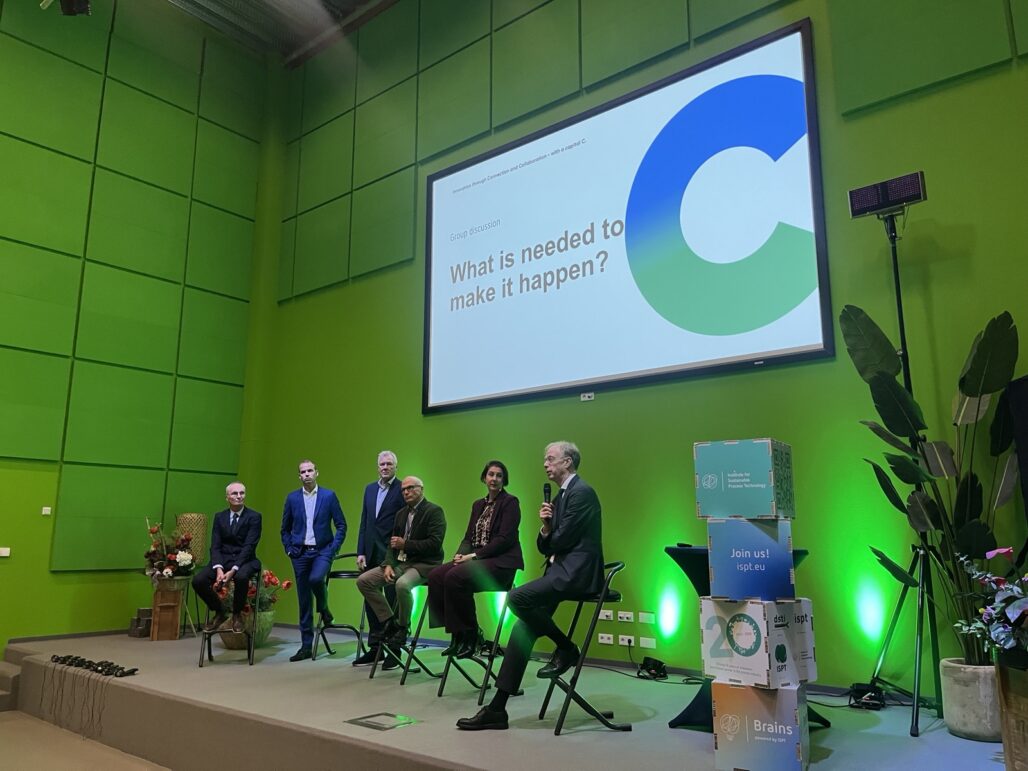
The closing discussion centred on politics. ‘Here in the Netherlands and across Europe, we’re keen to draw up plans – there are more than enough of them – but it’s all about implementation,’ says Alex Krijger, a geopolitical adviser and lecturer at Leiden University. ‘You can only expect businesses to bear the brunt of the transition if you also protect your own market.’
Maarten den Dekker, Chief Commercial & Sustainability Officer at North Sea Port, sees an imbalance. ‘Politicians are quick to spend billions to maintain today’s purchasing power. But making or facilitating investments that secure the purchasing power of the future is often very difficult.’
Companies that retain young people also bring their sustainability ethos into the organisation. This is highly developed among Gen Z. In his keynote speech, Krijger therefore addressed the question of how companies can retain that generation. ‘Listen very carefully to their values,’ he says. ‘They are very loyal to society and the planet, but this manifests itself differently from the older generation. Only then can you bind them to your organisation and your sustainability objectives.’
This article was originally published in Dutch on IndustrieLinqs