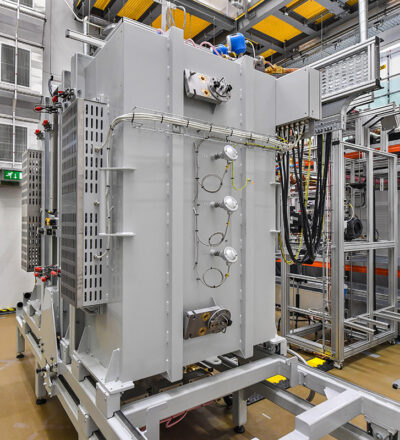
The e-Missi0n MOOI project successfully developed and demonstrated electric furnace technology for steam cracking, offering a promising pathway to decarbonize ethylene production. This collaborative initiative between Shell, Dow, TNO, and ISPT ran from 2021-2025 and investigated two electrification approaches: retrofitting existing furnaces with electric heating elements and developing novel reactor designs.
Key technical achievements
Indirect Electrical Heating (IEH): The project demonstrated that silicon carbide (SiC) heating elements can achieve the required heat flux (80 kW/m²) and temperatures (1100°C) for steam cracking. However, testing revealed durability challenges under cycling conditions, with elements unlikely to meet the targeted 4-year lifetime due to resistance increases and mechanical damage.
Direct Electrical Heating (DEH): The innovative concept using Joule-heated hanging tubes emerged as highly promising. Laboratory and pre-pilot testing successfully demonstrated stable operation at steam cracking conditions, with CFD modeling confirming comparable performance to conventional gas-fired furnaces while potentially reducing coking rates.
Novel reactor design: The evaluated narrow-bore reactor concept demonstrated improved heat delivery and reduced coking rates, compared to conventional systems for both naphtha and ethane cracking.
Heat integration: Advanced molten salt systems were developed to recover waste heat for feedstock preheating, potentially enabling complete heat reuse versus only 30% with conventional steam systems.
Economic and environmental impact
Techno-economic analysis revealed that e-cracking can be competitive with conventional cracking at electricity prices below ~67 €/MWh or CO₂ costs exceeding ~235 €/ton. The technology offers significant decarbonization potential: if one-third of global crackers were electrified, this would represent 59 million tons per annum of ethylene production and 90 million tons of avoided CO₂ emissions annually.
Technology readiness and outlook
The project successfully de-risked multiple technology pathways and delivered an engineering package for pilot-scale demonstration for the DEH concept. The comprehensive risk assessments and validated models provide a robust foundation for scaling to commercial deployment, contingent on favorable electricity pricing, renewable energy infrastructure development and the ability to economically valorize the methane rich fuel produced as a byproduct in the steam cracker.
This comprehensive work contributes significantly to the global development of steam cracking electrification technology, with pathways identified for achieving industrial-scale decarbonization of ethylene production.
Download your free copy
Our publications are free to access. Simply provide your first name and email address to download.