Membrane dewatering is a sustainable way to concentrate biomass without the phase-change penalty of thermal dewatering. Pressure driven dewatering induces fouling, severely reducing flux, and is unsuitable for shear- and pressure-sensitive species. Electro-osmotically (EO) driven membrane dewatering circumvents this, but the role of membrane properties is hardly explored. This study investigates how membrane morphology and properties of commercial polyethersulphone (PES) membranes govern EO transport and dewatering performance using an electrical potential as driving force.
Higher permeability is observed for feed solutions inducing the highest zeta potential and hydrophilicity at the membrane-liquid interface. As membrane pore radius and surface-to-volume ratio are interconnected, EO performance depends on a balance between both. The pore radius must be larger than the Debye length in the pores, but too large pores result in reduced S/V ratios thus inducing weaker interfacial effects. EO membrane dewatering performance of feeds with dispersed solids (Na-CMC; model biomass) shows the presence of solids in the feed enhances EO flow due to the significantly increased solid-liquid interfacial area available for water transport.
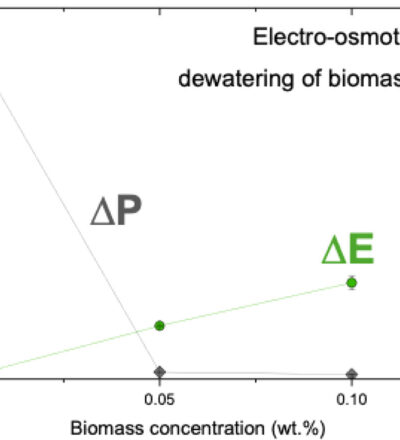
Depending on its properties, the membrane introduces additional transport resistance, emphasizing the importance of proper membrane selection. When experimentally comparing pressure and electrically driven membrane dewatering, pressure driven dewatering shows severe flux decline with increasing biomass concentration due to membrane fouling. Conversely EO permeation accelerates with increasing biomass concentration and much higher concentration factors are obtained. This gives EO-based membrane dewatering a significant advantage over pressure driven processes for the dewatering of biomass-feeds or shear- and pressure-sensitive species.
Download your free copy
Our publications are free to access. Simply provide your first name and email address to download.