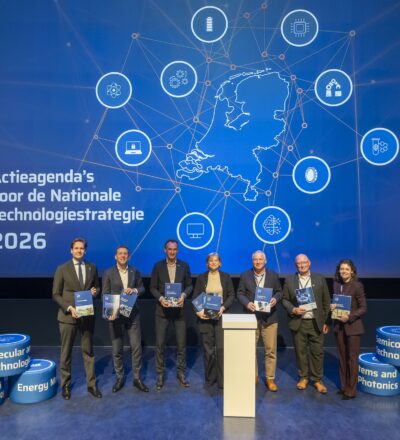
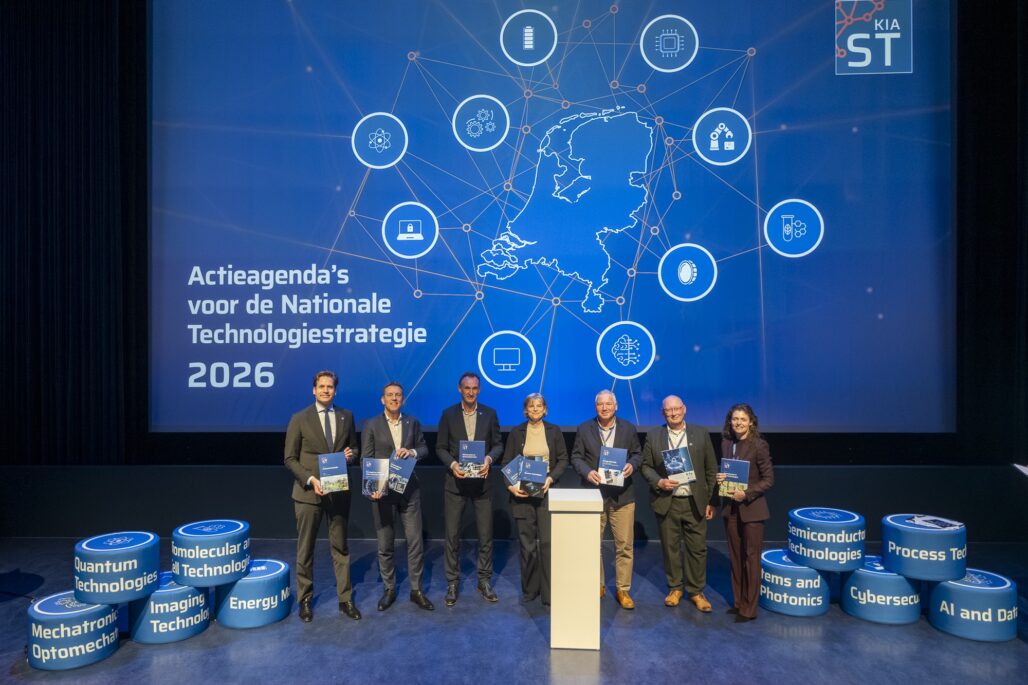
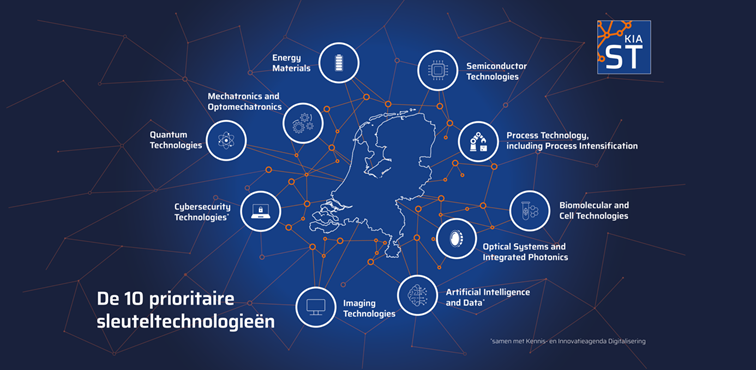
On Monday 26 January, the Key Enabling Technologies Knowledge and Innovation Agenda (Kennis- en Innovatieagenda Sleuteltechnologieën, KIA ST) formally presented the Action Agendas for the National Technology Strategy (NTS), together with an overarching recommendation, in the presence of Minister Vincent Karremans at a well-attended event in NEMO Science Museum. Across ten Action Agendas, the NTS ambitions for 2035 have been translated by more than 1,000 participating organisations into a coherent portfolio of 53 large-scale, multi-annual public–private innovation programmes, representing a total planned investment of more than €14 billion.
The ten Action Agendas offer a detailed overview of the technological breakthroughs, applications and ecosystems required to strengthen the Netherlands’ strategic position and earning capacity, and to reinforce the position of Dutch start-ups, scale-ups, SMEs and large enterprises. At the same time, they are a key instrument for addressing the major societal challenges facing the country.
Marco Waas (Nobian), Jasper van Zon (Nyrstar), Lisanne Blom (VNCI), and Irene ten Dam (ISPT) were present on behalf of the Process Technology Action Agenda. This key enabling technology focuses on strengthening Dutch earning capacity, strategic relevance, and achieving climate and environmental goals through innovation in process technology. The agenda supports the competitive position of industry, the creation of new value chains, and associated employment.
Vincent Karremans, Minister of Economic Affairs:
“The Netherlands is well positioned in key enabling technologies, with a highly skilled workforce, world-class technological expertise, a highly developed innovation ecosystem, and a globally leading high-tech business sector. The Action Agendas come at a pivotal moment, as geopolitical and economic pressures make targeted investment in innovation, technology and strategic autonomy essential. As a relatively small country, we must make clear choices and build on our strengths; that is why it is vital that investors commit on a sustained basis to the innovation programmes set out in these Action Agendas. Together, we can successfully bring the technologies of the National Technology Strategy to market, strengthen our earning capacity and reinforce the strategic autonomy of the Netherlands and Europe.”
Marc Lemaître, Director-General for Research and Innovation at the European Commission, said in a video message:
“The Netherlands has long been a powerhouse of innovation in Europe. Your impressive work of preparation of the action agendas to implement the National Technology Strategy dovetails perfectly with Europe’s ambition to be more competitive and resilient in a rapidly changing world. […] What you are developing nationally strengthens Europe as a whole. Leadership in key enabling technologies is of vital importance. In a world of accelerating technological change and growing weaponization of resource and technologies, investing in areas such as AI, quantum, semiconductors, biotechnology, advanced materials, cybersecurity and advanced optical systems is a strategic necessity for Europe’s economic strength, security and resilience. […] Europe’s future competitiveness will be built by shared ambition, cooperation and European scale. By its National Technology Strategy and strong participation in Horizon Europe, the Netherlands is in fact showing the way.”
Peter Stolk, Chair of the Key Enabling Technologies Knowledge and Innovation Agenda (KIA ST):
“We are pleased to present these Action Agendas, which reflect more than €14 billion in multi-annual innovation activity across 53 programmes. They combine established initiatives that we will now scale further with new innovation pathways that will strengthen the Netherlands’ international strategic position. At the same time, they sharpen priorities and support well-founded choices. This is the starting point: we are moving immediately into the next phase—intensifying collaboration, mobilising finance, accelerating scale-up and strengthening international partnerships—together with existing and new partners across the ecosystem.”
The Action Agendas are a starting point for further joint innovation. In the coming years, efforts and collaboration on the priority key enabling technologies will be further linked to, and aligned with, other recent reports and developments, including the Wennink Rapport, the Regional Strengthening Plan for the National Technology Strategy Regional Strengthening Pland for the National Technology Strategy (RV-NTS) of the Regional Development Agencies, the National Growth Fund programmes and relevant European initiatives.